by Brian Wholley
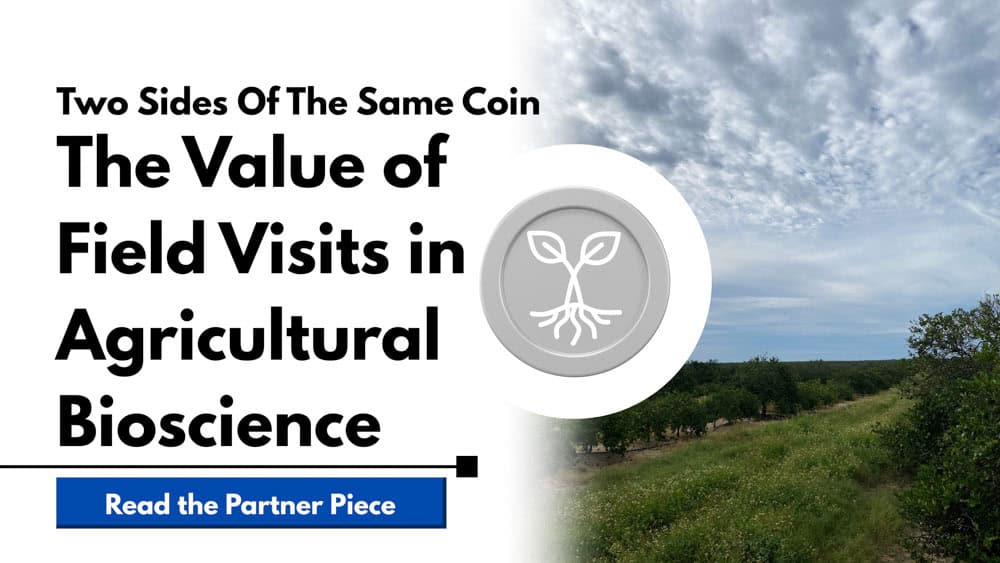
Agriculture moves fast—weather shifts quickly, pest pressure evolves week to week, and soil conditions can change dramatically within a single season. That’s why spending time in the field is one of the most important parts of my role. Every visit gives us a real-time view of how crops are responding, where stress is building, and how our biological solutions are performing under true commercial conditions. It’s a level of insight you simply can’t get from behind a desk.
When I step onto a customer’s farm or grove, I’m there to learn. I take soil, root, and leaf samples so our lab team can analyze microbial activity and plant health indicators at a deeper level. I listen closely as growers explain what they’re seeing—whether it’s uneven growth, early signs of disease, nutrient tie-up, or questions about new products on the market. These conversations help us understand not just the science, but the practical realities that shape a grower’s decision-making each season.
Field days are also an opportunity to measure our products against real-world challenges. I look at how our biologicals perform next to competitive inputs, evaluate mixing practices and application timing, and track results across different soil types and growing conditions. These observations feed directly into product recommendations, trial design, new product development, and customer support. They also help us ensure that the solutions we bring forward are genuinely delivering value where growers need it most.
Most importantly, these visits are about partnership. Agriculture is hands-on, and so are we. By staying connected to the field—literally—we strengthen the bridge between growers and our lab and R&D teams. Every sample collected and every conversation had becomes fuel for better diagnostics, better innovation, and better outcomes. It’s this continuous loop of field insight and scientific validation that helps us bring high-performing, reliable bioscience solutions to farms and groves.
Field observations are only half of the picture. The samples collected during these visits become the starting point for deeper scientific analysis in our lab—where controlled testing reveals why plants and microbes behave the way they do in real-world conditions. For a closer look at how those field samples translate into actionable data, explore our companion piece, “The Role of Field Samples in Generating Real, Actionable Bioscience.”